








Most American homeowners are surprised to learn that certified contractors outperform non-certified peers in both quality and safety compliance. The difference is more than just paperwork, with industry data showing that certification leads to fewer project delays and legal headaches. Credentials matter because they validate a contractor’s training, skills, and professionalism. Choosing a certified American contractor can mean fewer risks, better results, and greater peace of mind for any major home project.
Table of Contents
- What Certified Contractors Are And Why Credentials Matter
- Certification Standards And Required Qualifications Explained
- How Certification Impacts Safety And Work Quality
- Legal Protections And Warranty Advantages For Homeowners
- Comparing Certified Vs. Non-Certified Contractors
Key Takeaways
| Point | Details |
|---|---|
| Certified Contractors Ensure Quality | Hiring certified contractors guarantees a structured approach to project management, enhancing workmanship and minimizing risks. |
| Credentials Enhance Safety and Performance | Certification leads to higher adherence to safety protocols and superior work quality due to rigorous training and compliance. |
| Legal Protections for Homeowners | Certified contractors offer substantial legal safeguards and warranty advantages, reducing legal risks associated with home improvement projects. |
| Investment in Professional Standards | Choosing certified over non-certified contractors ensures a commitment to ongoing professional development and industry best practices, resulting in a dependable service experience. |
What Certified Contractors Are and Why Credentials Matter
Certified contractors represent skilled professionals who have completed rigorous training, testing, and validation processes that demonstrate their expertise in specific construction and home improvement disciplines. These credentials go far beyond simple professional licenses, serving as powerful indicators of a contractor’s commitment to quality, safety, and ongoing professional development. When homeowners choose a certified contractor, they are selecting a professional who has proven their capabilities through standardized industry assessments.
The significance of contractor credentials becomes clear when examining how industry-recognized credentials validate professional expertise. These certifications are not merely decorative documents, but comprehensive evaluations of a professional’s technical knowledge, practical skills, and understanding of industry best practices. Certification programs typically require professionals to demonstrate proficiency through written examinations, practical skills tests, and ongoing education requirements. This ensures that certified contractors maintain current knowledge about emerging technologies, safety protocols, and advanced techniques in their specific trade.
Key characteristics of certified contractors include:
- Comprehensive technical training in specific construction disciplines
- Verified skills through standardized assessment processes
- Commitment to ongoing professional development
- Up-to-date knowledge of industry safety standards
- Proven track record of meeting professional performance benchmarks
By selecting a certified contractor, homeowners gain significant advantages. These professionals bring not just technical skills, but a structured approach to project management that minimizes risks, ensures quality workmanship, and provides peace of mind. Credentials serve as vital indicators of a professional’s skills and knowledge, transforming what could be a potentially stressful home improvement project into a reliable, professional experience.
Certification Standards and Required Qualifications Explained
Certification standards in the construction industry represent comprehensive frameworks that ensure professionals demonstrate exceptional technical competence, safety awareness, and professional expertise. These rigorous standards go beyond basic licensing requirements, establishing precise benchmarks for skill validation and continuous professional development. Standardized training and assessments enable professionals to earn credentials reflecting their proficiency across specialized construction trades, providing homeowners with measurable assurances about a contractor’s capabilities.
Typical certification standards encompass multiple critical elements that comprehensively evaluate a contractor’s professional qualifications. These typically include:
- Extensive documented work experience
- Successful completion of specialized technical training programs
- Passing comprehensive written and practical examinations
- Ongoing professional education requirements
- Adherence to strict industry safety and performance protocols
Certain professional certifications, such as the Certified Construction Manager credential, represent particularly demanding qualifications. These advanced credentials require a sophisticated combination of educational background, substantial professional experience, and successful completion of comprehensive examinations, demonstrating a contractor’s commitment to maintaining the highest professional standards. Such certifications serve as powerful indicators of a professional’s ability to manage complex projects efficiently, safely, and with exceptional technical expertise.

Ultimately, certification standards protect homeowners by establishing clear, measurable benchmarks for professional competence. They ensure that certified contractors possess not just theoretical knowledge, but proven practical skills, updated technical understanding, and a commitment to maintaining the highest levels of professional performance. By choosing certified professionals, homeowners can confidently invest in home improvement projects, knowing their contractors have been rigorously evaluated and validated by respected industry organizations.
How Certification Impacts Safety and Work Quality
Certification plays a critical role in elevating both safety standards and work quality within the construction industry, serving as a comprehensive mechanism for ensuring professional excellence. Certified professionals are significantly more likely to adhere to rigorous safety protocols and deliver higher quality work, as their comprehensive training emphasizes industry best practices, technical precision, and consistent performance standards.
The impact of certification on safety and quality can be observed through several key dimensions:
- Systematic risk management strategies
- Advanced technical knowledge and skill verification
- Comprehensive understanding of industry safety regulations
- Commitment to continuous professional development
- Proven track record of meeting stringent performance benchmarks
Beyond traditional safety considerations, certifications also drive improvements in overall project quality and sustainability. Sustainable building certifications demonstrate how professional credentials can establish stringent environmental and quality standards, ensuring that contractors not only complete projects safely but also with exceptional attention to long-term performance and environmental responsibility. Certified contractors approach each project with a structured methodology that minimizes potential errors, reduces workplace accidents, and delivers consistently superior results.
Ultimately, certification serves as a powerful assurance mechanism for homeowners. By selecting certified professionals, clients gain access to contractors who have proven their ability to execute complex projects with technical precision, unwavering safety consciousness, and a demonstrable commitment to maintaining the highest professional standards. This approach transforms home improvement from a potential risk into a carefully managed, professionally executed experience that prioritizes both human safety and exceptional craftsmanship.
Legal Protections and Warranty Advantages for Homeowners
Certified contractors provide homeowners with substantial legal protections and warranty advantages that extend far beyond traditional service agreements. Hiring certified professionals significantly reduces the risk of legal complications by ensuring compliance with industry standards and regulatory requirements, creating a robust framework of protection for homeowners undertaking complex renovation or construction projects.
Key legal protections associated with certified contractors include:
- Comprehensive professional liability coverage
- Adherence to stringent state and local building regulations
- Documented work quality and performance standards
- Transparent contract terms and explicit warranty provisions
- Structured dispute resolution mechanisms
- Mandatory professional insurance requirements
Certified contractors are more likely to provide extensive warranties and maintain higher levels of business credibility, which directly translates to enhanced legal safeguards for homeowners. Professional certifications act as a critical mechanism for establishing accountability, ensuring that contractors remain committed to delivering exceptional work and standing behind their professional commitments. These credentials create a structured environment where homeowners can confidently pursue home improvement projects with minimal legal risk.
Ultimately, the legal protections offered by certified contractors represent a sophisticated risk management strategy for homeowners. By selecting professionals with verifiable credentials, clients gain access to contractors who understand complex legal requirements, maintain rigorous professional standards, and prioritize transparent, legally compliant project execution. This approach transforms home improvement from a potential legal minefield into a carefully managed, professionally executed experience that protects the homeowner’s investment and provides peace of mind.
Comparing Certified vs. Non-Certified Contractors
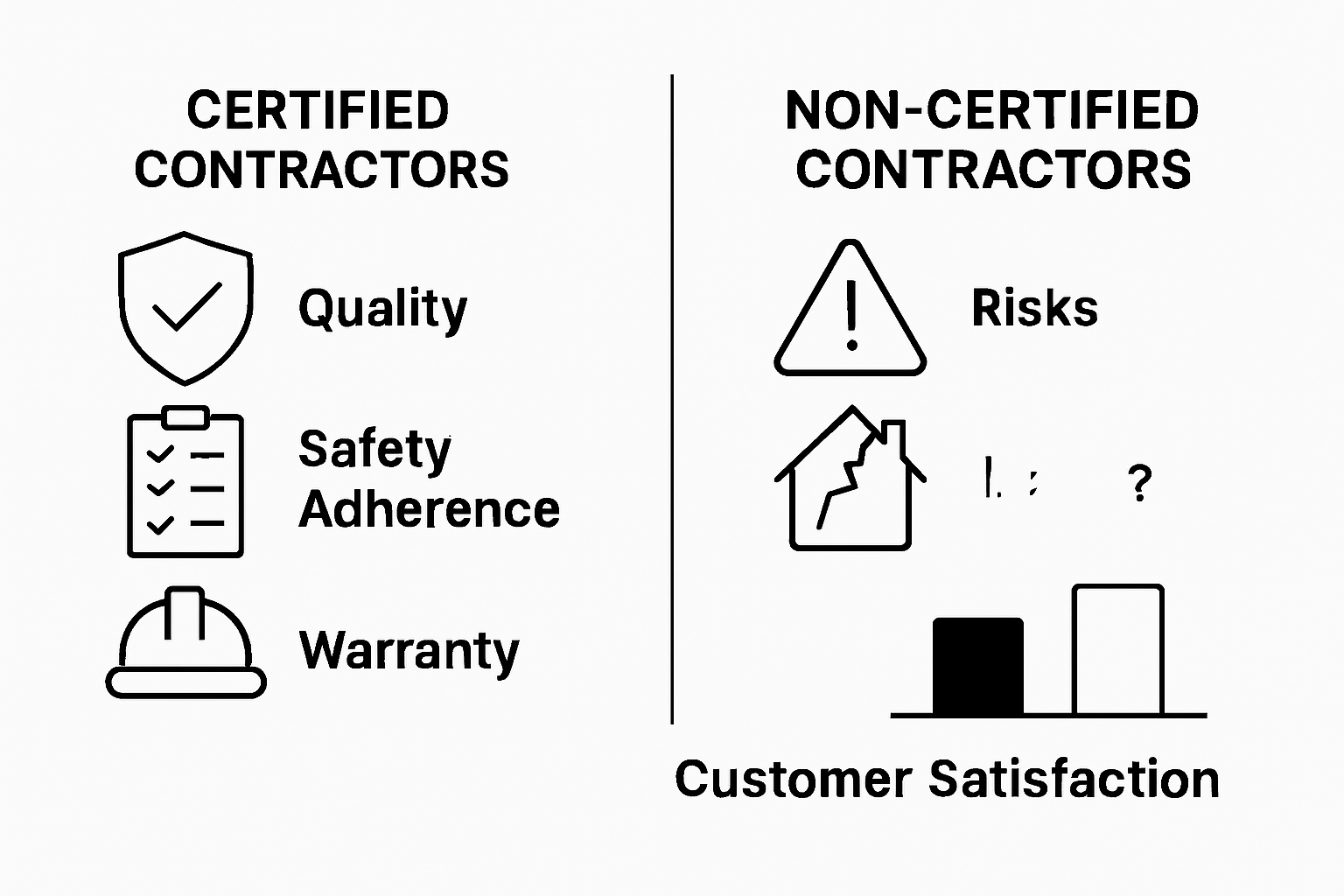
Certified contractors demonstrate a substantially higher commitment to professional development and industry standards, creating a profound difference in work quality, safety, and overall project execution compared to non-certified professionals. This distinction goes beyond mere paperwork, representing a comprehensive approach to craftsmanship that directly impacts homeowners’ experiences and project outcomes.
Key differences between certified and non-certified contractors become evident across multiple critical dimensions:
- Technical Expertise
- Certified: Rigorous, standardized training
- Non-Certified: Inconsistent skill levels
- Safety Protocols
- Certified: Comprehensive safety compliance
- Non-Certified: Variable safety standards
- Professional Accountability
- Certified: Structured professional development
- Non-Certified: Limited professional oversight
- Quality Assurance
- Certified: Consistent performance benchmarks
- Non-Certified: Unpredictable work quality
- Legal Compliance
- Certified: Strict regulatory adherence
- Non-Certified: Potential regulatory gaps
Certified contractors consistently demonstrate higher levels of safety regulation and quality standards, providing homeowners with a more reliable and professional service experience. Professional certifications function as a critical quality control mechanism, ensuring that contractors not only possess technical skills but also maintain a commitment to continuous improvement and industry best practices.
Ultimately, the choice between certified and non-certified contractors represents more than a simple hiring decision. It is a strategic investment in project quality, safety, and long-term satisfaction. Homeowners who prioritize certified professionals gain access to a structured, accountable approach to home improvement that minimizes risks, ensures superior craftsmanship, and provides comprehensive protection throughout the project lifecycle.
Choose Certified Contractors for Peace of Mind and Superior Results
Home improvement projects come with significant challenges including safety, quality, and legal concerns. As the article highlights, certified contractors deliver proven expertise through rigorous training, verified skills, and strict adherence to industry standards. This means less risk and higher quality for your home. When you choose professionals who demonstrate commitment via recognized credentials you gain confidence in every phase of your renovation or construction project.
At J. A. Kelly Contracting Services, we understand the importance of certification and quality workmanship. Our certified team specializes in residential renovations, roofing, decks, and flooring with a focus on safety and customer satisfaction. Experience firsthand why certified contractors provide unmatched peace of mind by exploring our expert services in the Uncategorized Archives – J. A. Kelly Contracting Services.

Ready to secure your home’s future with trusted certified professionals Visit J. A. Kelly Contracting Services today to schedule your free consultation and discover how our certifications protect your investment. Don’t settle for less when it comes to your home.
Frequently Asked Questions
Why should I hire a certified contractor for my home projects?
Hiring a certified contractor ensures that the professional has undergone rigorous training and testing, demonstrating a commitment to quality, safety, and ongoing education. This minimizes risks and guarantees quality workmanship for your home improvement projects.
What qualifications should I look for in a certified contractor?
Look for certifications that include extensive documented work experience, successful completion of specialized training programs, and passing comprehensive written and practical exams. Additionally, ongoing professional education requirements are vital for maintaining current knowledge in the field.
How does certification impact the safety of my home improvement project?
Certified contractors are significantly more likely to adhere to rigorous safety protocols, reducing the risk of workplace accidents and ensuring compliance with industry safety standards. Their training emphasizes systematic risk management strategies that protect both workers and homeowners.
Are there legal protections when hiring a certified contractor?
Yes, hiring certified contractors provides substantial legal protections, such as compliance with industry standards, documented work quality, and explicit warranty provisions. This structured framework helps minimize legal risks for homeowners undertaking construction or renovation projects.
Recommended
- Why Hire Certified Contractors for Home Projects – J. A. Kelly Contracting Services
- Role of Roofing Certifications – Why Homeowners Benefit – J. A. Kelly Contracting Services
- How to Find Reliable Contractor for Home Projects Easily – J. A. Kelly Contracting Services
- Why Hire a Contractor: Complete Homeowner Guide – J. A. Kelly Contracting Services